
Carbon Offset Fraud Investigation Minneapolis
When federal relief funds designated for vulnerable communities are redirected into speculative financial instruments, serious questions arise regarding compliance, transparency, and public accountability.
Investigation Led By Richard Jeffries & Jennifer Harrelson
Feb. 22, 2026 Updated 8:36 p.m. ET
That concern lies at the heart of recent findings regarding the use of approximately $930,000 in American Rescue Plan Act (“ARPA”) funds administered through the Minneapolis Park & Recreation Board (“MPRB”). According to an investigative memorandum prepared by a multi-state research team and pro bono counsel, ARPA funds intended for neighborhood-level climate relief and equitable pandemic recovery were used to support a carbon-offset initiative that subsequently generated marketable environmental credits. The memorandum recommends review by the U.S. Treasury Office of Inspector General, the Minnesota Attorney General, and relevant state oversight authorities.
The initiative at issue, branded as the “Twin Cities Climate Resiliency Initiative” was publicly presented as an environmental justice and urban forestry program via taking trees that were already planting, bundling them, and marketing them to hedge funds and polluters. These plantings were subsequently aggregated and monetized through carbon registries by Green Minneapolis (now operating as Green Cities Accord) as “urban forest” credits, which were marketed to corporate purchasers including Xcel Energy, CenterPoint Energy, the Minnesota Wild, Winslow Capital, and other institutional buyers. Please note the Green Cities Accord is not an independent non-profit seeking to aid communities via innovative funding sources for tree planting. Green Cities Accord is a simple rebranding of Green Minneapolis, which was an offshoot of the Minneapolis Downtown Council Greening and Public Realm Committee, chaired by David Wilson. We will show you the list of individuals involved in the original committee and illustrate how it became a think tank for the privatization of our urban forests. If you’re questioning this, simply look at their tax returns.
The memorandum further references findings from an independent Verification and Validation Body (VVB) engaged in connection with the City Forest Credits program. The VVB reportedly identified mismatched purchase orders and incomplete verification of planting documentation. Despite noting that more than 5,000 invoices were missing or unaccounted for, the verifier concluded that such deficiencies were “understandable, considering the size of the project,” and the credits were nonetheless issued. In addition, the investigation raises concerns regarding geographic equity. Although ARPA funding was publicly justified as benefiting disadvantaged census tracts, preliminary analysis suggests that a significant portion of the funded plantings occurred in comparatively higher-income neighborhoods. If federal funds were allocated on representations tied to equity metrics but expended in a materially different manner, that discrepancy may warrant further review under federal grant compliance standards.
The memorandum also cites email correspondence indicating that, during the relevant planting season, MPRB retained available funds within its Tree Preservation and Restoration Levy sufficient to support tree-planting activities without ARPA supplementation. The existence of alternative funding sources may bear on the statutory requirement that ARPA expenditures be “necessary” and proportionate to the stated public purpose.
Under federal guidance, recipients of ARPA funds must maintain detailed project-level documentation, implement adequate internal controls, and ensure that expenditures withstand audit scrutiny. In this instance, ARPA-funded plantings appear to have formed the foundation for a revenue-generating carbon-credit system. The methodology underlying the credits—including carbon sequestration estimates and associated co-benefit calculations—has been traced to a limited group of technical contributors involved in both state-level stormwater guidance and the City Forest Credits protocol.
The memorandum further outlines overlapping professional relationships, campaign contributions, and informal communication channels involving certain MPRB officials and affiliated nonprofit leadership. It alleges that personal and campaign email accounts were used to coordinate strategy through entities described as a “Green Infrastructure Steering Committee” or “Climate Resiliency Steering Committee,” which do not appear to have formal public authorization. Minnesota law is clear that communications concerning public business remain subject to public-records requirements regardless of the account used. If private accounts were utilized to conduct official deliberations, those communications may be subject to disclosure and review.
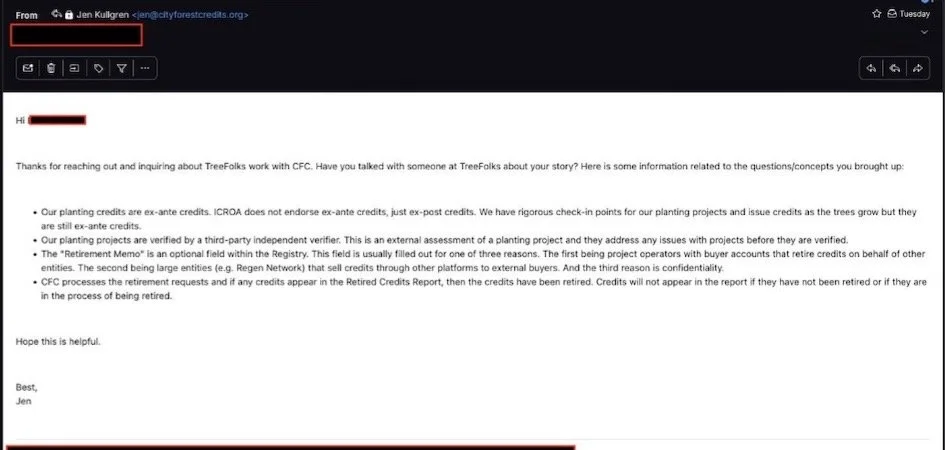
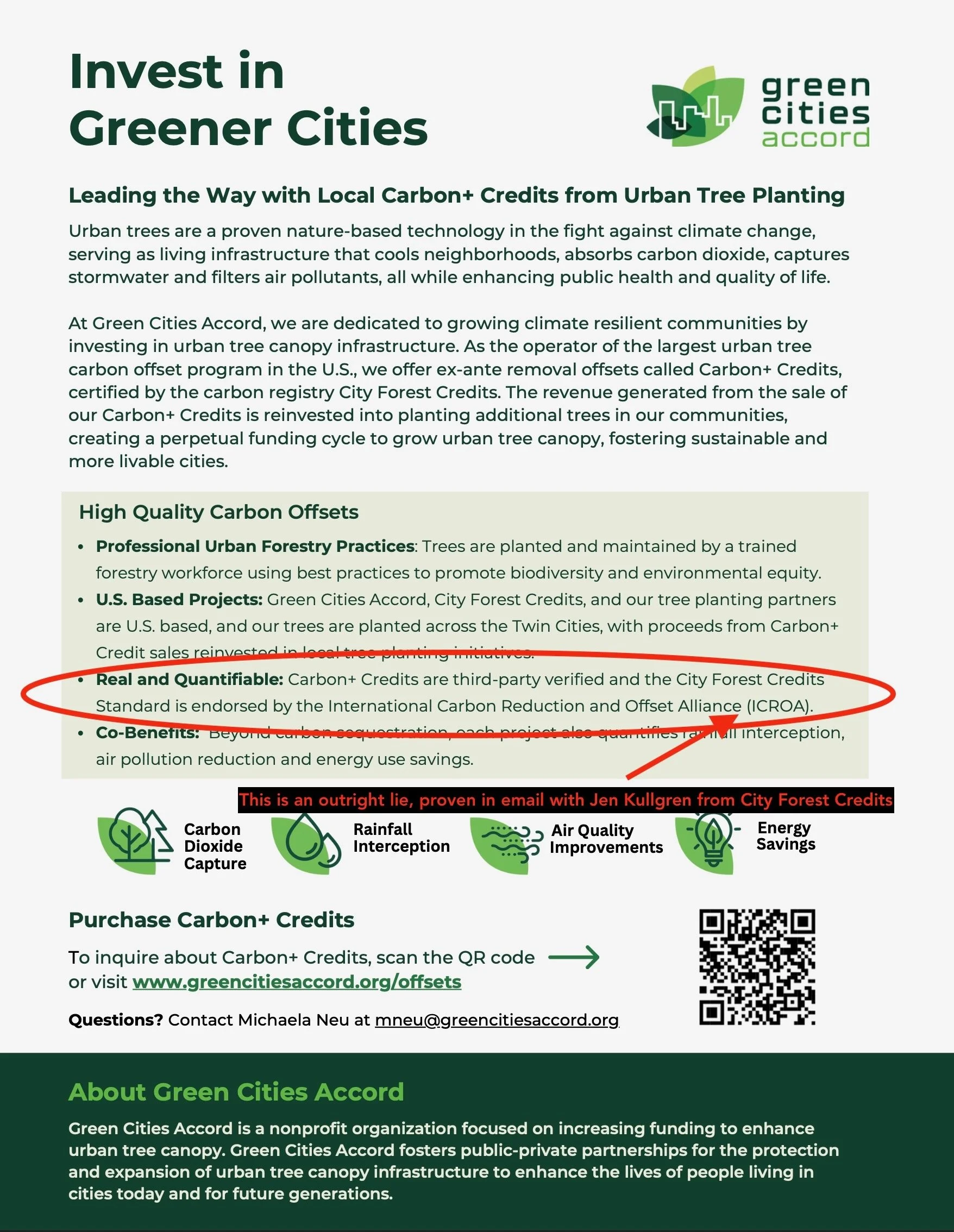
Separate concerns relate to marketing representations. Documentation indicates that the credits were described as “ICROA-certified” and “high quality.” However, the International Carbon Reduction and Offset Alliance (ICROA) does not certify ex-ante urban tree-planting credits of this type. If purchasers, regulators, or ratepayers were presented with inaccurate characterizations regarding certification status, such representations could implicate state consumer-protection and environmental marketing statutes, particularly where credits were incorporated into regulatory filings or public-utility innovation plans.
Collectively, these issues raise significant questions regarding grant compliance, conflicts of interest, internal controls, transparency obligations, and the proper use of federal relief funds.
ARPA was enacted to provide targeted pandemic recovery assistance, with explicit emphasis on equity, demonstrable public benefit, and rigorous accountability. Federal recipients are required to monitor subrecipients, maintain auditable records, and ensure that expenditures align with approved purposes. Public messaging and narrative descriptions cannot substitute for reconciled ledgers, invoice verification, and documented internal oversight; especially when leadership at MPRB made it clear that there were ample funds left over from a previous levy to plant trees, eradicating the fabricated emergency need for funding.
These recommendations reflect established principles of public finance and administrative law. Federal funds administered at the local level remain subject to federal standards of necessity, proportionality, documentation, and transparency. At minimum, taxpayers and residents are entitled to a clear and auditable accounting of whether ARPA-funded plantings were implemented in accordance with federal law and local representations. Public confidence in climate policy—and in government stewardship more broadly—depends upon rigorous oversight, transparent documentation, and the consistent application of accountability standards.
The central question is straightforward: whether the Twin Cities Climate Resiliency Initiative and the Minneapolis Downtown Council operated nonprofit—Green Cities Accord—functioned as a compliant, equity-focused public investment, or whether it marked the expansion of a privatized carbon market built upon publicly financed assets. That determination warrants careful, independent review. This is a warning and a favor to investors, hedge funds, companies, and any entity that purchased these credits—they are not legitimate, they are literally the worst possible offsets you can buy, and they are environmental-based futures and derivatives.
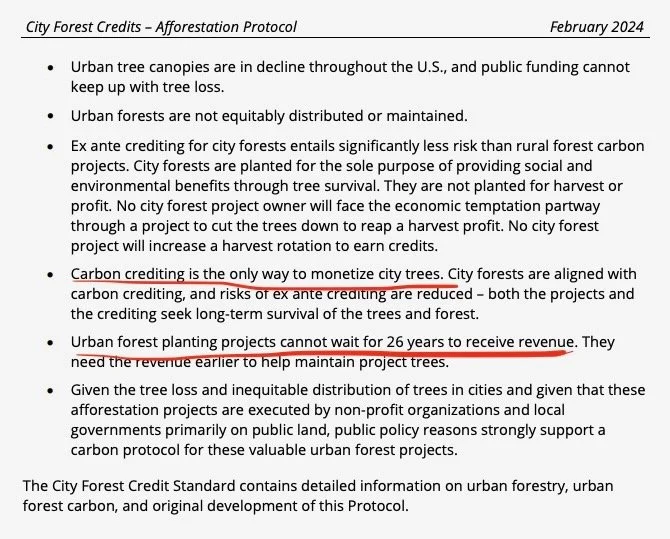
The individual who wrote the Minnesota Stormwwater Manual, which created the basis for these credits due to the fact that he co-authored it with the founder and 3rd party verifiers of City Forest Credits, stated that the average lifespan of an urban tree in a densely populated area is 13 years…these credits are based on the full benefits these trees will provide over 26 years. Our largest polluters get to keep these credits even if the tree dies, meaning these credits are based on trees planted in the past (failing additionality), are the worst possible investment anybody could make, and are rooted in a standard that Verra refuses to back, despite GCA claims that Verra supports their projects — they 100%, without question, do not.
This story begins with a former Accenture executive who masterminded the Strong-Mayor system in a successful effort to create a government structure that is fully privatized for downtown, the rich and corporate interests. This entire story twists and turns over a nine years period and requires an understanding of carbon markets, hedge funds, big energy, government structure, privatization, and the concept of futures and derivatives. We will be publishing this story over the course of this year, beginning with the Minneapolis Downtown Council Greening and Public Realm committee in 2017, and ending with the largest urban forestry and voluntary carbon market fraud case in the history of the United States.
Take the Money & Run
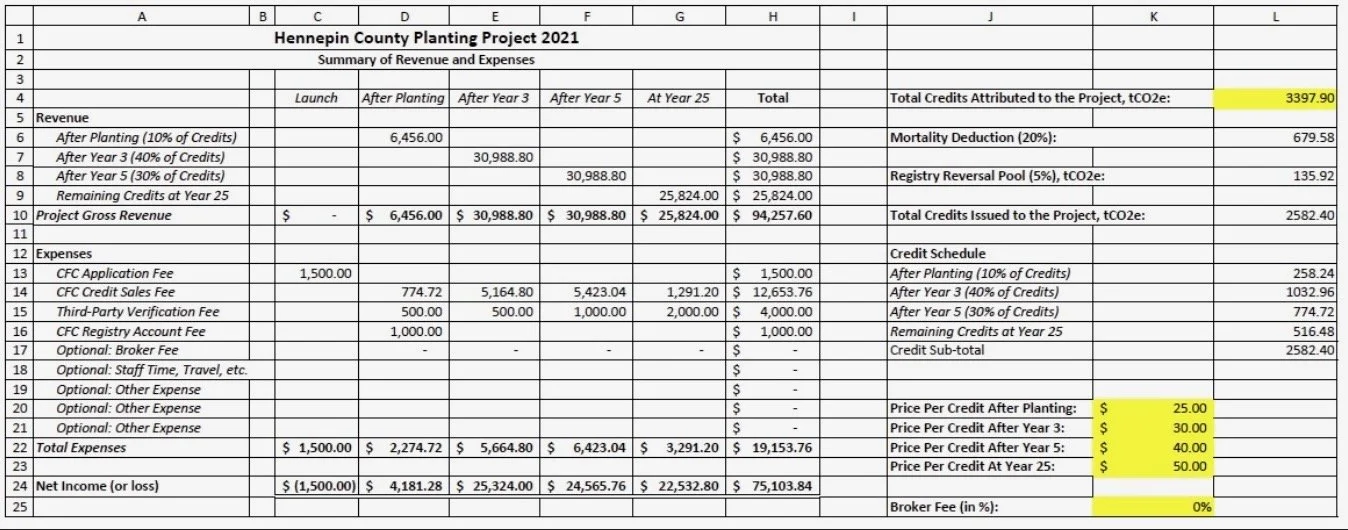
Let’s Start With What’s Owed to the City of Minneapolis taxpayer via the Minneapolis Park and Recreation Board as of today. David Wilson and Green Minneapolis promised to sell at credits at $35/credit, with all proceeds going directly to plant trees. As of today, David Wilson has retired from Green Cities Accord, which means that all contracts signed by him and the Minneapolis Park and Recreation Board, as well as City Forest Credits, must be updated to reflect his departure. This would’ve been a good thing to do before he absconded with carbon offsets worth millions of dollars. The accounting below reflects how much is owed if issued all credits that have been sold. This isn’t speculation, it is the actual amount promised by David Wilson and Green Cities Accord when they agreement was signed.

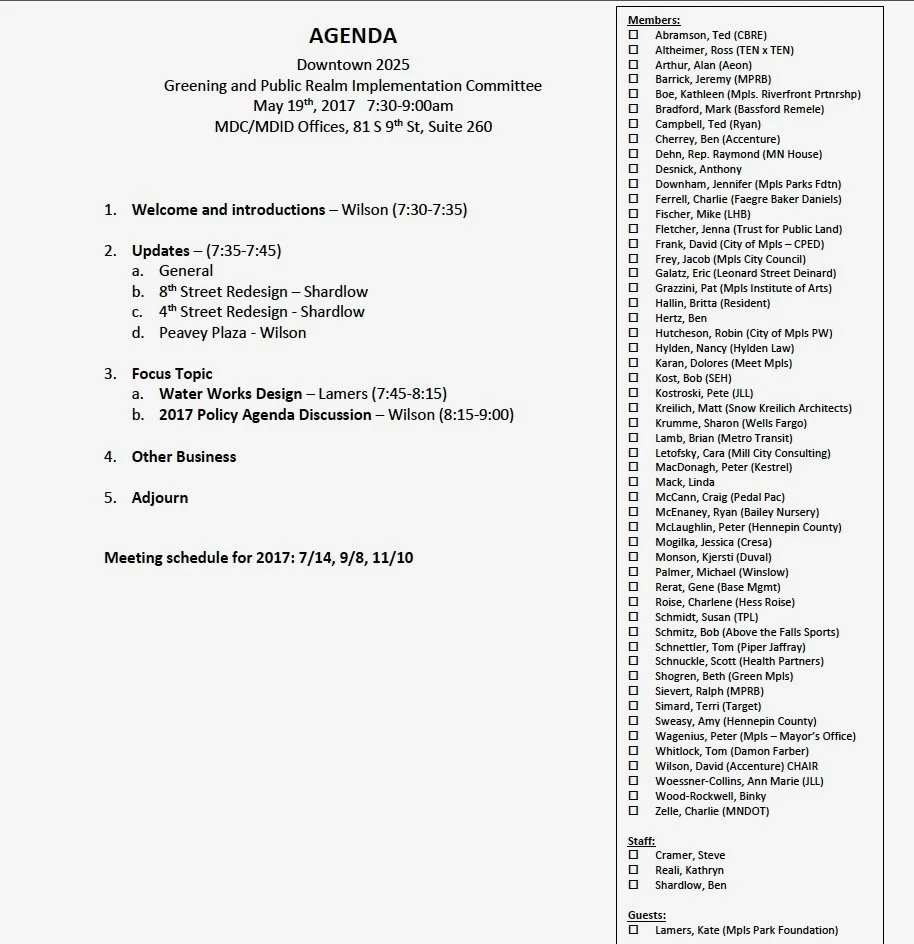
The Original Coalition: Downtown 2025 Greening and Public Realm Implementation Committee
Public records show that as early as 2017, a “Greening and Public Realm Implementation Committee” operated under the Minneapolis Downtown Council’s Downtown 2025 initiative. This is the bureaucratic origin story of how we came to be in this situation. This was not a casual advisory group—by the time the carbon offset program formally launched, the coalition was already built. The overlap in leadership, institutional representation, and thematic focus makes one thing clear: Minneapolis’ carbon market evolved from an established downtown power structure — not from grassroots environmental demand. Understanding who was aligned in 2017 is essential to understanding how public forestry assets were later converted into marketable carbon instruments.
The committee was chaired by David Wilson (Accenture) and included:
Minneapolis Park & Recreation Board Assistant Superintendent of Environmental Stewardship and ringleader, Jeremy Barrick
Minneapolis Park and Recreation Board Director of Forestry Ralph Sievert
Peter MacDonagh - World famous stormwater expert and Owner of Kestrel Design Group, Chair of the Minneapolis Tree Advisory Commision. Peter co-authored the Minnesota Stormwater Manual and urban forestry methodology alongside Greg McPherson (founder of City Forest Credits) and Qingfu Xiao (3rd party verifier)
Green Minneapolis
The Trust for Public Land (Current Green Cities Accord partner)
Minneapolis Parks Foundation (Current Green Cities Accord partner)
Meet Minneapolis (Current Green Cities Accord partner)
Hennepin County (Current Green Cities Accord partner)
MNDOT (Current Green Cities Accord partner)
Ryan Companies (Current Green Cities Accord partner)
Jacob Frey - Current Mayor of Minneapolis (Ensured ARPA funding reached David Wilson, despite objections from City Finance)
Nancy Hylden - Hylden Law, represented Feeding Our Future ringleaders
Winslow Capital (who funded the feasibility study for the carbon offset market to pursue the voluntary carbon offset market as potential ESG and portfolio boosting financial instruments)
Major financial institutions
Urban design firms who later received a supermajority of contracts related to public greening
Sustainability consultants
Downtown corporate stakeholders
The most powerful people in Minneapolis
City of Minneapolis officials
Faegre Baker Daniels (Jacob Frey’s former employer and Kingmaker)
This was not a casual advisory group. It assembled the same public officials, private consultants, and capital interests that would later design, implement, market, and purchase Minneapolis’ carbon credits.
The Usual Suspects
The Report: Greenwashing Minneapolis: “We Can’t Breathe”
Deceptive Trade Practices; Environmental Marketing Claims
Minnesota Statute §3.25E.41 Deceptive Trade Practices; Environmental Marketing Claims
Subdivision 1.Adoption of federal guides.
(a) Environmental marketing claims made by a manufacturer, packager, wholesaler, or retailer for a product sold or offered for sale or distribution in this state, including those related to the product's packaging, must conform to the standards or be consistent with the examples contained in Code of Federal Regulations, title 16, part 260, "Guides for the Use of Environmental Marketing Claims" regarding general environmental benefits claims, claims that a product or package is degradable, compostable, recyclable, or contains recycled content, and claims relating to source reduction, refillability, or ozone safety.
(b) Paragraph (a) does not apply to an environmental claim unless the claim is made in an attempt to influence purchasing decisions by end users of the product.
Subd. 2.Investigation; enforcement. A person who violates this section is subject to the penalties and remedies in section 8.31.
Treasury Guidance and Federal Law Governing ARPA Bookkeeping and Oversight
1. Statutory Authority
American Rescue Plan Act of 2021, Pub. L. 117-2, §§ 602–603 (adding 42 U.S.C. 802–803) “Recipients shall maintain such records as are necessary to evidence compliance with this section, regulations issued under it, and guidance from the Secretary of the Treasury.”
2. Implementing Regulation — 31 C.F.R. Part 35 (Subpart C and § 35.150)
§ 35.150 Recordkeeping and Reporting
“Recipients must maintain records and financial documents sufficient to evidence compliance … and must provide such records upon request of Treasury.” “Recipients must retain records for a period of five years after the end of the covered period.”
§ 35.150(b) Internal Controls
“Recipients must establish and maintain effective internal controls … that provide reasonable assurance of compliance with Federal statutes, regulations, and the terms and conditions of the award.”
§ 35.150(c) Subrecipient Monitoring
“Recipients are responsible for oversight of subrecipients … to ensure that subawards are used for authorized purposes and in compliance with laws, regulations, and the terms and conditions of the award.”
3. Treasury SLFRF Compliance and Reporting Guidance
(U.S. Department of the Treasury, latest rev. Apr 2024)
Key directives:
● “Maintain project-level financial and performance records demonstrating that costs are necessary and proportionate to the public purpose.”
● “Each project must be assigned a unique Project ID and documented with invoices, contracts, and proof of payment.”
● “Recipients must ensure segregation of duties and reconciliation of ledgers against source documentation.”
● “Narrative summaries alone are insufficient; quantitative evidence must support all reported outputs.”
4. Uniform Administrative Requirements — 2 C.F.R. Part 200 (Subpart D & F)
§ 200.303 Internal Controls
“The non-Federal entity must establish and maintain effective internal control over the Federal award that provides reasonable assurance … of compliance with Federal statutes,regulations, and the terms and conditions of the Federal award.”
§ 200.331 Subrecipient Monitoring and Management
“The pass-through entity must evaluate each subrecipient’s risk … and monitor activities to provide reasonable assurance that the subaward is administered in compliance.”
§ 200.334 Retention Requirements for Records
“Financial records, supporting documents, statistical records, and all other records pertinent to a Federal award must be retained for a period of three years … longer if required by statute or regulation.”
§ 200.501 Audit Requirements
“A non-Federal entity that expends $750,000 or more in Federal awards … during the fiscal year must have a single or program-specific audit conducted.”
5. Relevant Federal Statutes for Non-Compliance
● 18 U.S.C. § 1001 — False Statements (knowingly submitting false or misleading information to the U.S. Government).
● 18 U.S.C. § 666 — Theft or Bribery Concerning Programs Receiving Federal Funds.
● 31 U.S.C. § 3729 — False Claims Act (civil liability for knowingly presenting a false claim for payment from Federal funds).
Employment Conflict of Interest
● Commissioner Musich is employed by U.S. Bank, which has been cited in climate resiliency planning documents as a sponsor and is a donor to Green Minneapolis/Green Cities Accord.
● This may present a conflict of interest under Minneapolis Code of Ethics Chapter 15 (Conflicts of Interest – Outside Employment/Financial Interest), specifically MinneapolisCode of Ordinances Chapter 15, §15.40 prohibits city officials from participating in decisions where they have a financial interest due to outside employment.
● Documentation shows Musich involved in motions and votes advancing Green Minneapolis projects without recusal.
● U.S. Bank has been identified in City climate resiliency planning documents as a potential sponsor and is a known donor/sponsor of Green Minneapolis, the nonprofit intermediary managing carbon credit and tree canopy projects for MPRB.
● This also raises concerns under Minn. Stat. §10A.07, subd. 1, which requires public officials to disclose and avoid conflicts of interest when taking action that could substantially affect their financial interests or those of an associated business.
● MPRB Commissioners voted against the development of an independent oversight entity being created to handle ethics complaints regarding MPRB activity, which should be reevaluated
● In the documentation below, you will see Green Minneapolis and Steffanie Musich (as well as Meg Forney) included in the email where they submitted a partnership proposal letter to US Bank on 10/18/2021
● Minn. Stat. §10A.09 requires disclosure of economic interests; these relationships warrant review.
Campaign Finance Contributions – Pay-to-Play Concern
● Campaign finance records show contributions to Commissioner Musich’s campaign from David Wilson (Executive Director of Green Cities Accord/Green Minneapolis) in 2021 and 2025
● Steffanie Musich was vital for the success of Green Minneapolis (now known as Green Cities Accord) and can be seen in every Board meeting regarding this issue and courting other commissioners to ensure its success
● This raises concerns of a pay-to-play dynamic, where political donations coincide with financial arrangements under Commissioner Musich’s current jurisdiction.
● This issue falls under both local ethics provisions and oversight of the Minnesota Campaign Finance and Public Disclosure Board for review.
● It also implicates Minn. Stat. §10A.09, requiring accurate disclosure of economic interests to the Campaign Finance and Public Disclosure Board
● We would also like to point out that Steffanie Musich was the Board Appointee to MIA in 2023, and hosted Director of MIA, Katie Luber, at her rooftop sauna during COVID,which us a questionable engagement.Considering MPRB passes MIA almost $20 million dollars of Hennepin County taxpayer dollars every year, an investigation into how those funds are used is merited given the severity of this case and the fraud involved.
● Commissioner Musich has also received campaign finance donations from Counsel Brian Rice and his family members, which we believe presents a serious conflict ofinterest regarding his ability to ethically and responsibly oversee this complaint in a neutral, professional capacity. We also don’t believe the City of Minneapolis can handle this case responsibly, and require this complaint to be sent to the Minnesota Attorney General, the Minnesota State Attorney, and the United States Treasury department todetermine how to handle this case.
City of Minneapolis / MPRB Ethics Code - Use of Personal Gmail and Musich4Parks, Megforney.org for MPRB Business.
Steffanie Musich used her personal Gmail account and her campaign email to communicate with David Wilson, Craig Wilson, and other Green Infrastructure and Climate Resiliency Steering Committee members on many occasions, have conducted official business on behalf of residents. In addition, Meg Forney used her campaign website, “megforney.org” to avoid detection. This evidence surfaced as part of a data request to the City of Minneapolis and showed that Musich, Forney, Linea Palmisano and other elected officials, alongside private interests, were part of the "Green Infrastructure Steering Committee", which has never been an official entity. These communications occurred prior to the 2021 MOU with Green Minneapolis, suggesting early coordination outside official channels. Meg Forney used her campaignemail, and continues to do so for all communications with David Wilson.
Using personal accounts for public business can create compliance issues under the Data Practices Act, Campaign Finance statutes (§211B.12, §211B.13), and City ethics provisions. Minneapolis Code of Ethics Chapter 15 requires officials to maintain transparency and avoid impropriety. Using a personal Gmail blurs accountability, especially if it avoids oversight or archiving and It creates the appearance of trying to hide official business. Courts in Minnesota and other states have ruled that using personal accounts to avoid disclosure is illegal if the intent is to shield communications.
If MPRB decisions and actions that significantly affect the public were deliberately made behind closed doors via the use of personal email (Gmail), those emails should be subpoenaed in litigation or forced into public disclosure. Using non-official accounts risks violating: Campaign finance rules (§211B.12, §211B.13) if campaign accounts are used, and Public records law if personal Gmail accounts are used without retention.
Secret Meetings for “Green Infrastructure Steering Committee”, “Climate Resiliency
Steffanie Musich used her personal Gmail to push a Downtown-centric and corporate Greenwashing centered approach to climate change. Steffanie Musich and all of the individuals named in this document were part of this committee and was led by Linea Palmisano doing the bidding (as shown below) at theCouncil and Steffanie Musich and Meg Forney ensured that any vote that favored David Wilson was secured, alongside commissioners that were clearly compromised.
There is direct evidence of this, which can be found by going to the Project page on City Forest Credits website, specifically: “https://www.cityforestcredits.org/carbon-credits/carbon-registry/minneapolis-forest-carbon-offsets-2/”, and open the document titled “Initial Project Design Document”. Navigate to page 132 and note that all rows highlighted in blue are for the 2022 planting project. Ralph Sievert, who doesn’t appear to be at MPRB Forestry at this point, attested to the accuracy and honesty of these plantings. This means that every row highlighted in blue that says “More Trees Please” under the “Project” column was planted used Federal ARPA relief funds. Not only did Ralph Sievert verify these plantings, he ensured that thefund used to plant these trees was noted.
The $1 million dollars granted by the City of Minneapolis only passed the initial stages because Jeremy Barrick and David Wilson promised that the trees would be planted in designated census tracts—which is not something they are in charge of, and cannot promise.
Public funds are now being traded between our largest polluters, retired anonymously by Green Cities Accord without any mention of by who, and money has gone into the pockets of the project operator and the registry for trees that are dead, insufficient to provide any benefits, and/or have yet to fully establish. The Minnesota Wild, Sunrise Bank, Xcel Energy, Hennepin County, the City of Saint Paul, Centerpoint Energy, The Nature Conservancy, The Trust for Public Land, and an overwhelming amount of entities were told that these were “high quality offsets”. Due to the Reversal Pool included within the agreement, these trees can die and the credits remain untouched, which means that all of the entities offsetting their emissions could be offsetting a dead tree, while keeping emissions unchanged.
Without verifying that the money was used appropriately, Steffanie Musich and Meg Forney introduced and ensured the passage of resolutions preserving this relationship. In addition, Green Cities Accord claims that their planting projects are “ICROA Certified”, when in fact, not a single tree planted is ICROA certified because ICROA does notcertify Ex-Ante planting projects, due to the fact that they are the lowest possible quality offset. To clarify, ICROA does not certify offsets for things that haven’t happened yet. We would like an explanation for why Green Cities Accord and Steffanie Musich can essentially greenwash the entire project, fabricate quality to consumers, and ultimatelyimpact agreements between the PUC, Xcel, and Centerpoint.
This also means that Green Cities Accord, in coordination with Commissioners, have been untruthful to Winslow Capital hedge fund, which is a subsidiary of Nuveen andTIAA, which could have implications on teachers’ retirement accounts, public debt, and a host of other financial liabilities are tied up in this case. Investors and every day peopleare affected by low quality and unverified offsets being marketed as high quality and ICROA certified credits, neither of which are true.
Most importantly, this quest to privatize our environment begins with a lie from Green Cities Accord shown below. Although ex-post projects are certified via Verra—as shown in the email above—Ex-Ante projects are not. When David Wilson and Green Cities Accord claim that you’re receiving “Carbon+” Credits, which are certified by a “3rd party”, they are referring to random individuals that simply ensure that your paperwork has been completed correctly. They simply sign off…and never view a single tree in person. I could say that I planted 20,000 trees in St. Louis and send City Forest Credits an application, but not a single person would ever visit St. Louis to verify the existence of a single tree. This is a fraudulent scam from the start. They are lying because Ex-Ante credits do not fall under the same category as achieved preservation benefits—these are City Forest Carbon Forward Removal CreditsTM. Knowing that it would be more difficult to sell benefits that haven’t happened yet, and will not occur for 25 years, Green Cities Accord and David Wilson decided to simply tell investors that these are “Carbon+” credits, jeopardizing the entire market and proving that the urban forestry voluntary carbon offset market is rooted in false claims and imagined benefits.
As Mayor Frey allows the Feds to target our Somali community, despite his involvement, we’ve tracked how roughly $930 000 in ARPA allocations intended for neighborhood-level climate equity and recovery were absorbed by a constellation of quasi-public and private organizations—including Green Cities Accord (Formerly Green Minneapolis) of the Minneapolis Downtown Council, the Minneapolis Park and Recreation Board, Hennepin County and the City of Minneapolis Office of Sustainability—to launch carbon-offset and “urban-forest credit” projects that generated marketable assets but limited public accountability. This is not community resilience. It’s the quiet conversion of public money into speculative carbon instruments. What began as local relief for disadvantaged neighborhoods evolved into a prototype for privatizing the climate economy. Fraud is not “rampant in the Somali community”, it is rampant at Mayor Jacob Frey’s office.
According to planting audits and internal correspondence obtained through public-records requests, the ‘More Trees Please’ program—billed as an environmental justice initiative—reported 8,595 trees planted between April 11 and October 26 2022. The Park Board later confirmed that 2,291 of those were funded directly through ARPA while the remainder were financed through local operating budgets and external sponsors. The data trail shows that the same plantings were subsequently monetized through Green Minneapolis’s carbon-offset partnership with national registries, allowing credits to be sold to corporate buyers. The list of those buyers has included Xcel Energy, Centerpoint Energy, the Minnesota Wild, Winslow Capital Hedge Fund, and some of the most powerful entities in the country.
A 3rd party verifier at City Forest Credits found mismatched purchase orders and incomplete verification of planting sites. Additional documentation shows that former City of Minneapolis Sustainability titans and consultants—Craig Wilson of Sustology and Kim Havey, then director of the Office of Sustainability—played roles in program design while maintaining business or advisory relationships with participating vendors. Craig Wilson receives City consulting contracts across industries and should be fully audited. Kim Havey was approached after the unofficial Green Infrastructure Steering Committee—the predecessor to the Twin Cities Climate Resilience Steering Committee— ran into resistance at the City of Minneapolis Finance Office. In our official memorandum, we point out relevant federal statutes governing misuse of public funds, including 18 U.S.C. §1001 (False Statements), 18 U.S.C. § 666 (Theft or Bribery Concerning Programs Receiving Federal Funds), and 31 U.S.C. § 3729 (False Claims Act). The analysis argues that inaccurate or incomplete reporting to the U.S. Treasury could constitute a violation of ARPA’s compliance provisions, which require that all expenditures be “necessary and proportionate” and fully documented under 31 C.F.R. Part 35. When federal relief money ends up underwriting marketable carbon credits, the burden of proof is on the recipients. If planting data and financial records cannot be reconciled, the Minnesota Attorney General must step in.
Minneapolis’ program has drawn attention because the city has become a model for similar public-private offset ventures now appearing in Chicago, Denver, and Seattle. Many of those use the same technical consultants and carbon registries first deployed in Minneapolis. Minneapolis round zero for a new form of climate privatization, and unchecked replication could erode public trust in urban-forestry and sustainability initiatives nationwide. We strongly urge the Minnesota Attorney General, and local auditors to launch coordinated reviews of all ARPA-funded climate and forestry projects between 2019 and 2024. We’re also pushing for new state legislation requiring full disclosure of carbon-credit purchasers and stricter conflict-of-interest reporting for officials engaged in public-private environmental programs. Climate accountability starts with honest bookkeeping, and the Minnesota taxpayers—and the federal government deserve to know whether public funds built public benefit or private portfolios. We provide multiple primary sources of direct evidence for every claim we make. The sheer amount of tentacles involved in this fraud is staggering, and includes wood waste and the push to make woody biomass a renewable energy source, as well as the decision to declare waste to energy “carbon-free”.
Evidence contained in the accompanying complaint and exhibits indicates the following:
• Employment at U.S. Bank while participating in and voting on Green Minneapolis-related matters despite the bank’s status as a financial sponsor (violating Minn. Stat. §10A.07 and City Code §15.40; see State v. Serstock, 402 N.W.2d 514 (Minn. 1987)).
• Campaign contributions from David Wilson and MIA trustees contemporaneous with Green Cities Accord contracts, raising potential pay-to-play issues (Minn. Stat. §§10A.09, 211B.12–211B.13; U.S. v. Sun-Diamond Growers, 526 U.S. 398 (1999)).
• Misrepresentation of ARPA-funded “More Trees Please” tree-planting program locations, where evidence shows trees were planted predominantly in high-income tracts despite federal representations to the contrary (18 U.S.C. §1001, §666; 31 U.S.C. §3729).
• Coordination by public officials and private actors through the “Green Infrastructure Steering Committee,” an entity operating outside official authorization, raising Open Meeting and ethics concerns (Minn. Stat. §13D.01; In re Application of Olson, 884 N.W.2d 416 (Minn. 2016)).
•Former MPRB Commissioner Steffanie Musich used her personal Gmail and campaign email to avoid public detection prior to formal approval of this relationship, and Meg Forney used her campaign email throughout the entire process—and still does. In fact, all members of the steering committee have been using personal emails throughout this entire process, except for one—Citycouncilmember Linea Palmisano. If Councilmember Palmisano wouldn’t have used her City email, the public would have never known about a single page of this fraud.
The conduct described implicates multiple layers of statutory and ethical accountability. Under State v. Serstock = (402 N.W.2d 514 (Minn. 1987)), misuse of public office for personal benefit constitutes criminal misconduct. In Minnesota Daily v. Univ. of Minn. (432 N.W.2d 189 (Minn. 1988)), the court held that communications from personal accounts used for public business are subject to disclosure under the Data Practices Act. Federal precedent (U.S. v. Sun-Diamond Growers, 526 U.S. 398 (1999)) clarifies that gifts or contributions given in anticipation of official acts constitute illegal gratuities. Likewise, U.S. v. Agostino (132 F.3d 1183 (7th Cir. 1997)) applies honest-services fraud principles to deceptive conduct by public officials. Collectively, these precedents support the conclusion that coordinated concealment, misrepresentation of funding use, and self-dealing through Green Cities Accord meet thresholds for criminal and administrative enforcement.
Evidence also indicates that Green Cities Accord (formerly Green Minneapolis) and associated public officials misrepresented the certification and quality of carbon credits sold or promoted under the Minneapolis Tree Canopy/City Forest Credits program. Purchasers and partners were led to believe these offsets were “ICROA-certified” and “high-quality,” despite ICROA’s explicit policy against certifying ex-ante tree-planting credits. This constitutes false advertising and consumer fraud under both federal and state law. The most serious of false claims is the misrepresentation by Green Cities Accord to Xcel Energy, Centerpoint Energy, and the Public Utilities Commission, which has serious implications on all residents who rely on Centerpoint and Xcel. Our team received an email from City Forest Credits affirming this false claim, which is shown below. Green Cities Accord’s claim that these credits are “ICROA” certified, is unequivocally false.
Proof of False Claims
Why are forestry experts allowing Downtown business executives to claim benefits that haven’t happened, and why are there no checks on the status of these trees between years 5 and 25?
Simple: Due to Net Zero promises and disinvestment in clean energy, the big shots from the Downtown Council decided that instead of holding our largest polluters accountable, they’d simple use trees that have already been planted to claim Futures, which can be traded, bought, sold, held onto, or retired. They are financial instruments, nothing more, nothing less. Both Centerpoint and Xcel Energy have included Green Cities Accord as a significant portion of the Natural Gas Innovation Act. Approved in February 2025, Xcel Energy’s $55 million Minnesota Natural Gas Innovation Act (NGIA) plan aims to decarbonize its gas system by testing 13 pilot projects, including renewable natural gas (RNG) and electrification. The plan focuses on lowering emissions, supporting Minnesota's climate goals, and investing in new technologies for heating. To date, Xcel has retired 1,293 City Forest Carbon Forward Removal CreditsTM, and Centerpoint Energy has retired 800 credits. The reality is that the money given to MPRB ($100,000) was never used to plant trees, because MPRB had funds left over from the Tree Preservation and Reforestation Levy and were recently granted a $500,000 grant from the Metropolitan Council to remove and plant trees. Whichever way you look at this, we are simply being lied to by an individual who made a career off of privatizing governments—David Wilson—and now he has left Green Cities Accord with the bag.
The “experts” at City Forest Credits have a different explanation, and it has to be the most ridiculous attempt to justify fraud in the history of the voluntary market—manufacture a fake tree funding crisis, and profit off of trees that have already been planted in order to sell offsets that represent 2.7 metric tons/tree in order to satisfy ESG goals for hedge funds and corporations, and justify pollution. Make no mistake, City Forest Credits, David Wilson and Green Cities Accord, and their partners are going to lead to the worst air quality our city has ever seen. Literally, nothing has changed and even less trees have been planted since this scam begin, with only $100,000 going to MPRB.