
When federal relief funds designated for vulnerable communities are redirected into speculative financial instruments, serious questions arise regarding compliance, transparency, and public accountability.
By Richard Jeffries (Public Policy Investigator), Jennifer Harrelson (Forestry and Carbon Markets Investigator)
Feb. 22, 2026 Updated 8:36 p.m. ET
That concern lies at the heart of recent findings regarding the use of approximately $930,000 in American Rescue Plan Act (“ARPA”) funds administered through the Minneapolis Park & Recreation Board (“MPRB”). According to an investigative memorandum prepared by a multi-state research team and pro bono counsel, ARPA funds intended for neighborhood-level climate relief and equitable pandemic recovery were used to support a carbon-offset initiative that subsequently generated marketable environmental credits. The memorandum recommends review by the U.S. Treasury Office of Inspector General, the Minnesota Attorney General, and relevant state oversight authorities.
The initiative at issue, branded as the “Twin Cities Climate Resiliency Initiative” was publicly presented as an environmental justice and urban forestry program. Public records indicate that 8,595 trees were planted between April and October 2022. These plantings were subsequently aggregated and monetized through carbon registries by Green Minneapolis (now operating as Green Cities Accord) as “urban forest” credits, which were marketed to corporate purchasers including Xcel Energy, CenterPoint Energy, the Minnesota Wild, Winslow Capital, and other institutional buyers. Please note the Green Cities Accord is not an independent non-profit seeking to aid communities via innovative funding sources for tree planting. Green Cities Accord is a simple rebranding of Green Minneapolis, which was an offshoot of the Minneapolis Downtown Council Greening and Public Realm Committee, chaired by David Wilson. We will show you the list of individuals involved in the original committee and illustrate how it became a think tank for the privatization of our urban forests. If you’re questioning this, simply look at their tax returns.
The memorandum further references findings from an independent Verification and Validation Body (VVB) engaged in connection with the City Forest Credits program. The VVB reportedly identified mismatched purchase orders and incomplete verification of planting documentation. Despite noting that more than 5,000 invoices were missing or unaccounted for, the verifier concluded that such deficiencies were “understandable, considering the size of the project,” and the credits were nonetheless issued. In addition, the investigation raises concerns regarding geographic equity. Although ARPA funding was publicly justified as benefiting disadvantaged census tracts, preliminary analysis suggests that a significant portion of the funded plantings occurred in comparatively higher-income neighborhoods. If federal funds were allocated on representations tied to equity metrics but expended in a materially different manner, that discrepancy may warrant further review under federal grant compliance standards.
The memorandum also cites email correspondence indicating that, during the relevant planting season, MPRB retained available funds within its Tree Preservation and Restoration Levy sufficient to support tree-planting activities without ARPA supplementation. The existence of alternative funding sources may bear on the statutory requirement that ARPA expenditures be “necessary” and proportionate to the stated public purpose.
Under federal guidance, recipients of ARPA funds must maintain detailed project-level documentation, implement adequate internal controls, and ensure that expenditures withstand audit scrutiny. In this instance, ARPA-funded plantings appear to have formed the foundation for a revenue-generating carbon-credit system. The methodology underlying the credits—including carbon sequestration estimates and associated co-benefit calculations—has been traced to a limited group of technical contributors involved in both state-level stormwater guidance and the City Forest Credits protocol.
The memorandum further outlines overlapping professional relationships, campaign contributions, and informal communication channels involving certain MPRB officials and affiliated nonprofit leadership. It alleges that personal and campaign email accounts were used to coordinate strategy through entities described as a “Green Infrastructure Steering Committee” or “Climate Resiliency Steering Committee,” which do not appear to have formal public authorization. Minnesota law is clear that communications concerning public business remain subject to public-records requirements regardless of the account used. If private accounts were utilized to conduct official deliberations, those communications may be subject to disclosure and review.
Separate concerns relate to marketing representations. Documentation indicates that the credits were described as “ICROA-certified” and “high quality.” However, the International Carbon Reduction and Offset Alliance (ICROA) does not certify ex-ante urban tree-planting credits of this type. If purchasers, regulators, or ratepayers were presented with inaccurate characterizations regarding certification status, such representations could implicate state consumer-protection and environmental marketing statutes, particularly where credits were incorporated into regulatory filings or public-utility innovation plans.
Collectively, these issues raise significant questions regarding grant compliance, conflicts of interest, internal controls, transparency obligations, and the proper use of federal relief funds.
ARPA was enacted to provide targeted pandemic recovery assistance, with explicit emphasis on equity, demonstrable public benefit, and rigorous accountability. Federal recipients are required to monitor subrecipients, maintain auditable records, and ensure that expenditures align with approved purposes. Public messaging and narrative descriptions cannot substitute for reconciled ledgers, invoice verification, and documented internal oversight; especially when leadership at MPRB made it clear that there were ample funds left over from a previous levy to plant trees, eradicating the fabricated emergency need for funding.
These recommendations reflect established principles of public finance and administrative law. Federal funds administered at the local level remain subject to federal standards of necessity, proportionality, documentation, and transparency. At minimum, taxpayers and residents are entitled to a clear and auditable accounting of whether ARPA-funded plantings were implemented in accordance with federal law and local representations. Public confidence in climate policy—and in government stewardship more broadly—depends upon rigorous oversight, transparent documentation, and the consistent application of accountability standards.
The central question is straightforward: whether the Twin Cities Climate Resiliency Initiative and the Minneapolis Downtown Council operated nonprofit—Green Cities Accord—functioned as a compliant, equity-focused public investment, or whether it marked the expansion of a privatized carbon market built upon publicly financed assets. That determination warrants careful, independent review. This is a warning and a favor to investors, hedge funds, companies, and any entity that purchased these credits—they are not legitimate, they are literally the worst possible offsets you can buy, and they are environmental-based futures and derivatives.
The individual who wrote the Minnesota Stormwwater Manual, which created the basis for these credits due to the fact that he co-authored it with the founder and 3rd party verifiers of City Forest Credits, stated that the average lifespan of an urban tree in a densely populated area is 13 years…these credits are based on the full benefits these trees will provide over 26 years. Our largest polluters get to keep these credits even if the tree dies, meaning these credits are based on trees planted in the past (failing additionality), are the worst possible investment anybody could make, and are rooted in a standard that Verra refuses to back, despite GCA claims that Verra supports their projects — they 100%, without question, do not.
This story begins with a former Accenture executive who masterminded the Strong-Mayor system in a successful effort to create a government structure that is fully privatized for downtown, the rich and corporate interests. This entire story twists and turns over a nine years period and requires an understanding of carbon markets, hedge funds, big energy, government structure, privatization, and the concept of futures and derivatives. We will be publishing this story over the course of this year, beginning with the Minneapolis Downtown Council Greening and Public Realm committee in 2017, and ending with the largest urban forestry and voluntary carbon market fraud case in the history of the United States.
“The Original Coalition: Downtown 2025 Greening Committee (2017–)”,
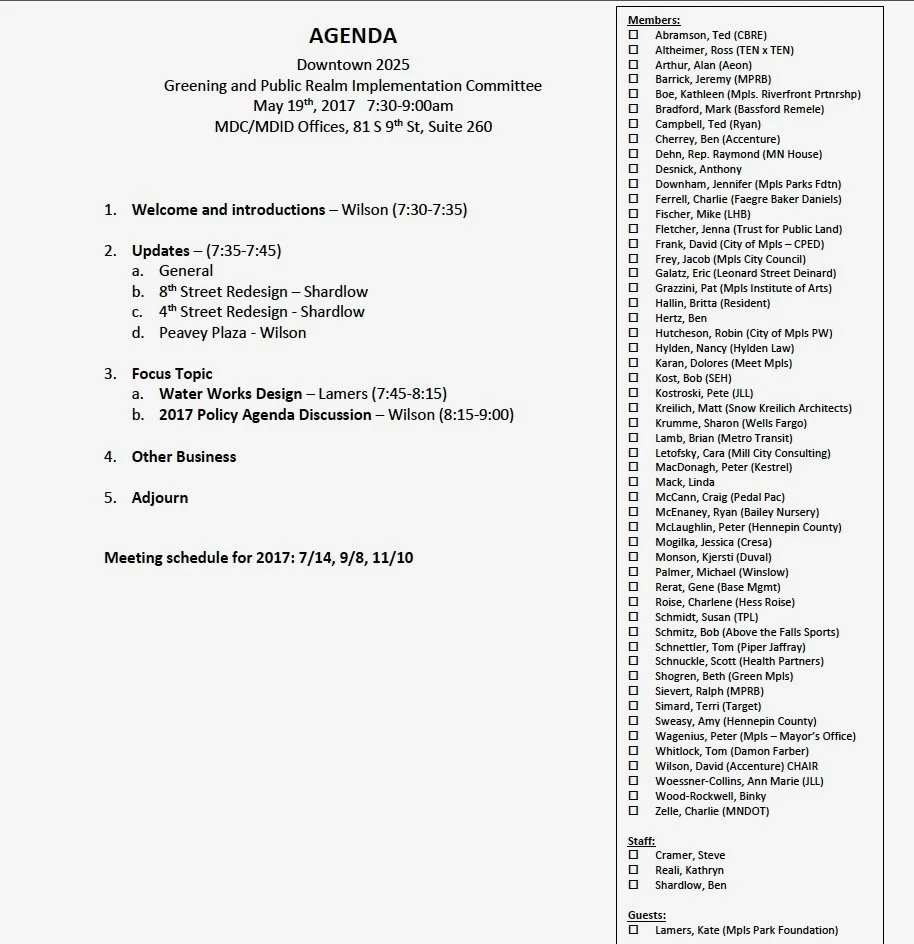
Public records show that as early as 2017, a “Greening and Public Realm Implementation Committee” operated under the Minneapolis Downtown Council’s Downtown 2025 initiative.
The committee was chaired by David Wilson (Accenture) and included representatives from:
Minneapolis Park & Recreation Board
Green Minneapolis
Winslow Capital
Major financial institutions
Urban design firms
Sustainability consultants
Downtown corporate stakeholders
The most powerful people in Minneapolis
The creator of the Minnesota Stormwater Manual Tree section, who co-authored it with Greg McPherson (founder of City Forest Credits) and Qingfu Xiao (3rd party verifier)
The Carbon Market Didn’t Appear Overnight
The Minneapolis carbon offset program did not materialize spontaneously. It grew out of an organized network that was already operating years before credits were ever issued.
Public records from 2017 show that the Minneapolis Downtown Council convened a “Downtown 2025 Greening and Public Realm Implementation Committee,” chaired by David Wilson (then of Accenture). The roster included:
Minneapolis Park & Recreation Board forestry leadership
Green Minneapolis representatives
A Winslow Capital representative
Urban design firms
Major financial institutions
Jacob Frey
Nancy Hylden of Hylden Law (Mayor Jacob Frey’s wife’s (Sarah Clarke) former employer, who represented defendants in the Feeding Our Future case
Peter MacDonagh, whose stormwater and urban forestry methodology later underpins credit quantification and was co-authored with Greg McPherson (founder of City Forest Credits) and Qingfu Xiao (3rd party verifier)
City of Minneapolis officials
Faegre Baker Daniels (Jacob Frey’s former employee, featured in the Pandora Papers and renamed afterward)
Major downtown financial and corporate institutions
This was not a casual advisory group. It assembled the same public officials, private consultants, and capital interests that would later design, implement, market, and purchase Minneapolis’ carbon credits.
By the time the carbon offset program formally launched, the coalition was already built.
The overlap in leadership, institutional representation, and thematic focus makes one thing clear: Minneapolis’ carbon market evolved from an established downtown power structure — not from grassroots environmental demand.
Understanding who was aligned in 2017 is essential to understanding how public forestry assets were later converted into marketable carbon instruments.